
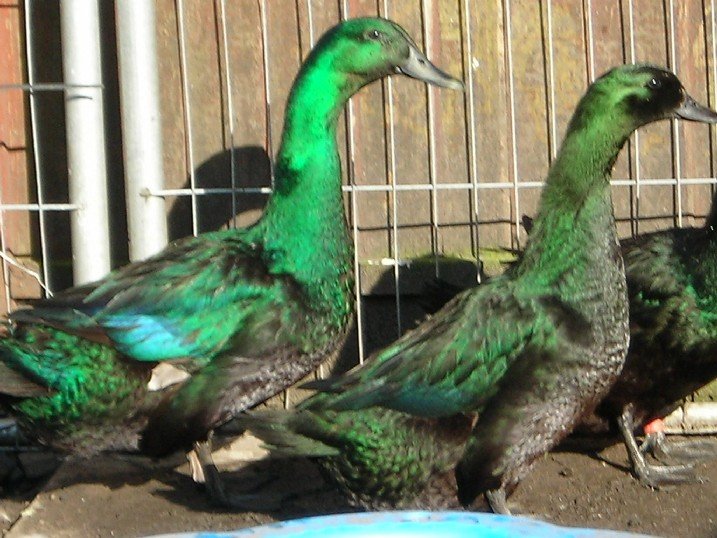
Ducks were the last species investigated, and I wasn't really pumped about the idea of them until I found a breed I liked. Meet the Cayuga Duck!
Selecting which variety of goose I wanted was more difficult than I thought it would be. I quickly narrowed it down to the African Goose or the Chinese Goose. Both are descendants from the wild Swan Goose.

The African Goose

The Chinese Goose

Their common ancestor, the Swan Goose
Honestly, I love the look of them. And they look fairly similar, especially if you only get the production lines of African (they don't have that dewlap on the chin). What the pictures don't show is that the African is twice the size of the Chinese, yet the Chinese can lay over 3 times as many eggs. They're both noisy and protective of their nests. I want them for meat mostly, so I was wondering if the Chinese would even be worth the trouble per bird. They only weigh 10 lbs each (2 lbs more than the chickens I plan to have) so I don't expect a lot of meat per bird. The Africans are larger, but that's a larger bird that can be very territorial, and one that lays less eggs, so less offspring. I'm still pretty torn on the goose breed. There's a farm around here that has both and it very open with information and farm tours. I'm hoping that once I see them and talk to them, I'll know if it's worth it to process a 10 pound goose, and if I can physically handle a 20 pound one.
So those are the selected poultry breeds right now. Anyone have any of these birds and have words of wisdom or words of caution?

